Leave Your Message
0%

So, why pick a Metal Chassisfor your product? Honestly, it’s more than just looking sleek. A well-designed Metal Chassis can really make a difference—protecting sensitive electronics, helping control the heat, and giving the whole product a solid, premium feel. I mean, it just feels sturdy in your hand. Plus, it tends to withstand repeated assembly, transport, and daily wear better than those thin plastic options out there.

Remember what Steve Jobs once said? He pointed out that “Design is not just what it looks like and feels like. Design is how it works.” And honestly, that idea still hits home for engineers designing products today. When they’re working on a metal chassis, it’s not just about how cool it looks—it’s about making sure it supports the whole system properly. That means paying attention to wall thickness, grounding points, vents, where to put fasteners, and even how to handle electromagnetic interference. They also need to think about sharp edges, how tough the coating is, resistance to corrosion, and how tight the manufacturing specs are. Little details like these truly make a difference.

And speaking of practicality, the benefits really come to light during testing. For example, a steel chassis might cut down on vibrations around the power supply, while an aluminum one could help spread heat away from the processor toward a finned surface—pretty clever stuff. Proper grounding not only keeps things safe but also protects signal quality. But here’s the thing—metal isn’t automatically the best choice for everything. It can add weight, bump up tooling costs, and make assembly trickier. If joints aren’t designed well, you might end up with rattles, repairs becoming a pain, or hotspots forming. That’s where experience really matters. Designers need to carefully weigh protection, weight, cost, how easy it is to service, and how many units they plan to make. Sometimes, going with a hybrid structure gives you the best of both worlds.

All in all, this isn’t just about picking a super-strong chassis—it’s about choosing the right one for your specific needs. Doing it right comes down to real engineering know-how, not just flashy marketing promises.
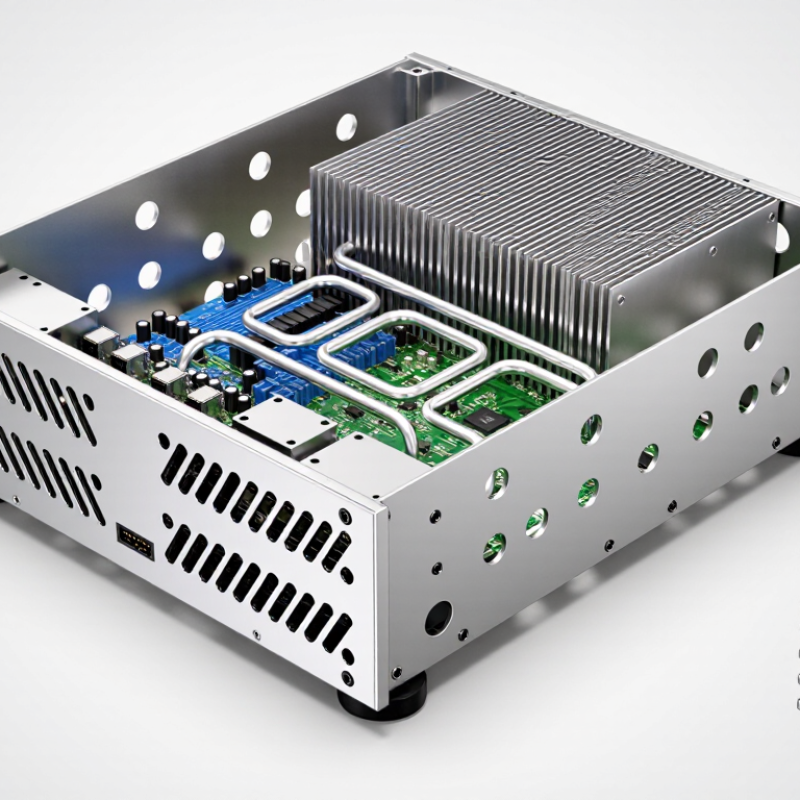
Why Choose a Metal Chassis for Your Product?

Material Selection: Aluminum Conducts ~205 W/m·K; Steel About 50 W/m·K

A Sheet Metal Chassis must move heat, not merely protect electronics. Aluminum conducts approximately 205 W/m·K, while common steel conducts about 50 W/m·K. These figures come from ASM Handbook, Volume 2, and align with engineering data published by the U.S. Department of Energy. Aluminum therefore transfers heat roughly four times faster through an equal material thickness. That difference matters around power modules, battery controllers, and compact processors.

Picture a 2 mm aluminum wall spreading heat from a small internal bracket. The surface can distribute warmth across a larger area before a fan removes it. Steel usually needs thicker sections, thermal pads, vents, or dedicated heat sinks. It remains useful where stiffness, impact resistance, shielding, and lower material cost dominate. However, conductivity alone does not predict enclosure temperature. Surface coatings, fastener contact, air gaps, and interface resistance can weaken aluminum’s advantage. This is where early prototypes often disappoint. The calculation looks clean. The assembly is not.

The International Aluminium Institute reports that aluminum remains widely used in transport and electrical applications because of its low density and recyclability. Steel still offers a strong structural baseline, especially for heavy equipment. Engineers should compare thermal conductivity, mass, corrosion protection, tolerances, and production volume together. A practical test uses thermocouples near the hottest component and on the outer panel. Record temperatures after steady operation, not after a brief startup. One honest warning: a poorly bonded aluminum panel may perform worse than expected. Material selection needs evidence from the finished chassis.

Why Choose a Metal Chassis for Your Product?

Thermal conductivity comparison at approximately room temperature

Aluminum conducts heat at approximately 205 W/m·K, while typical steel conducts about 50 W/m·K. This higher conductivity can help aluminum chassis components spread heat more efficiently, supporting passive cooling and thermal management.

Mechanical Protection: IK10 Enclosures Withstand 20 J per IEC 62262

A metal chassis gives a product a firm protective shell. It helps resist drops, tool strikes, vibration, and rough handling. For industrial equipment, this protection can preserve internal boards, connectors, and wiring. It also supports stable mounting inside cabinets, vehicles, and exposed service areas.

IK10 is a useful benchmark for mechanical protection. Under IEC 62262, an IK10 enclosure withstands an impact energy of 20 joules during standardized testing. The test uses a defined impact method, not an everyday accident. A metal enclosure may absorb and distribute the force better than thinner plastic designs. That can reduce dents, cracked covers, and dangerous access to live components.

But IK10 is not invincible. It does not prove resistance to corrosion, water, heat, or repeated impacts. A poorly fitted door can still fail in the field. Sharp corners may also create new risks after severe damage. Engineers should review material thickness, seams, fasteners, hinges, and internal clearances together. Test records matter. So does installation quality.

A practical evaluation should match the enclosure to its working environment. Check likely impact points, service tools, transport conditions, and mounting surfaces. Then confirm that the complete assembled product meets the intended rating, rather than testing only an empty shell. A metal chassis adds confidence, but careful design prevents confidence from becoming overconfidence.

Why Choose a Metal Chassis for Your Product? — Mechanical Protection: IK10 Enclosures Withstand 20 J per IEC 62262
Data Dimension Technical Data Practical Significance
Impact Protection Rating IK10 Indicates the highest impact-protection classification defined in the IK rating scale under IEC 62262.
Impact Energy 20 joules The enclosure is tested against an impact energy of 20 J, helping protect internal components from severe mechanical shocks.
Reference Standard IEC 62262 Defines the IK code used to classify the degree of protection provided by enclosures against external mechanical impacts.
Typical Test Method for IK10 Impact produced by a 5 kg test mass dropped from approximately 400 mm, subject to the specified test apparatus and conditions Provides a repeatable laboratory method for evaluating resistance to high-energy external impacts.
Enclosure Structure Rigid metal panels, formed sections, reinforced joints, and securely fastened covers Helps reduce deformation and maintain enclosure integrity during handling, installation, and accidental impact.
Protection of Internal Parts Mechanical barrier between external hazards and sensitive electronics Reduces the risk of damage to circuit boards, connectors, displays, power supplies, and wiring caused by knocks or falling objects.
Dimensional Stability Low thermal expansion compared with many common plastics; exact performance depends on the selected metal and design Supports stable mounting positions, panel alignment, and connector fit across changing operating temperatures.
Mounting Strength Suitable for threaded fasteners, brackets, rails, grounding points, and other mechanically loaded interfaces Enables robust installation in equipment cabinets, industrial machinery, transportation systems, and outdoor infrastructure.
Vibration and Shock Resistance Rigid construction can limit enclosure movement when properly fastened; system performance depends on the complete assembly Helps maintain reliable electrical connections in environments subject to transport vibration or operational shock.
Fire and Heat Behavior Metal is non-combustible, although coatings, seals, insulation, and internal materials must be evaluated separately Can provide a strong external barrier where resistance to ignition and elevated temperatures is important.
Electromagnetic Shielding Continuous conductive metal surfaces can support electromagnetic shielding when seams, doors, cable entries, and grounding are properly designed May help reduce radiated interference and improve immunity to external electromagnetic fields.
Corrosion Protection Depends on the base metal, surface treatment, coating system, fasteners, and operating environment Appropriate finishes and material selection can extend service life in humid, dusty, or industrial locations.
Design Verification IK10 classification should be confirmed through testing of the complete enclosure configuration Doors, windows, hinges, locks, cable glands, ventilation openings, and mounting arrangements can influence the final impact-protection result.
Important Limitation IK10 describes protection against mechanical impact only; it does not define ingress protection, corrosion resistance, electrical safety, or pressure resistance. Additional standards and application-specific testing may be required for the intended installation environment.

EMI Shielding: Design for FCC Part 15 Radiated-Emission Limits

Why Choose a Metal Chassis for Your Product?

A metal chassis can reduce radiated emissions by enclosing noisy circuits and controlling return-current paths. This matters when designing for FCC Part 15 radiated-emission limits. Metal is not magic. Its performance depends on continuous electrical bonding, careful geometry, and disciplined cable placement. In practical prototypes, a two-millimeter seam can become a surprising leakage path near a clock harmonic.

A reliable design starts with the source. Place high-speed processors, switching regulators, and crystal circuits away from enclosure openings. Use conductive gaskets around removable panels, but confirm their compression and contact resistance. Avoid unnecessary slots. When ventilation is required, use short, narrow openings and test their combined area. Bond connector shells directly to the chassis whenever possible. Filter external cables at the entry point, rather than several centimeters inside the enclosure.

Pre-compliance scans can reveal problems before formal testing, especially around cable exits and display openings. I have seen an enclosure pass low-frequency checks, then fail after a panel screw lost metal-to-metal contact. Small gaps matter. A painted surface may also interrupt bonding unless contact areas are deliberately prepared. These details are easy to miss, even in experienced teams. Measure with the final cable set, power supply, fasteners, and operating software. A metal chassis supports compliance engineering, but it cannot replace controlled layouts, repeatable assembly, and independent laboratory verification. unerquicklich

Environmental Sealing: IP65 Means Dust-Tight and Water-Jet Protected

Why Choose a Metal Chassis for Your Product?

A sheet metal charger chassis can support reliable environmental protection when its joints are designed carefully. Under IEC 60529, IP65 means complete protection against dust and protection from water jets. It does not mean immersion protection. A technician may see dust entering through one poorly compressed gasket, even when the enclosure looks robust.

The International Energy Agency’s Global EV Outlook 2024 reported more than four million public charging points worldwide in 2023. That expanding infrastructure places chargers beside roads, parking areas, workshops, and coastal locations. Metal construction provides useful rigidity around connectors, cooling openings, and cable glands. However, steel selection and surface treatment still matter. IP65 alone does not guarantee corrosion resistance.

Test the complete assembly, not only the empty enclosure. Check door compression, weld seams, fastener holes, gland plates, and connector interfaces. During a water-jet test, inspect the interior for droplets near power terminals. Small details matter. A 2023 enclosure survey from a professional electrical engineering publication noted that sealing failures often occur at interfaces rather than flat panels. This matches practical installation experience, although field conditions can be less controlled than laboratory tests.

IP ratings can be overpromised. They are not magic shields. Design reviews should consider vibration, thermal cycling, maintenance access, and damaged gaskets. A metal chassis earns trust when its protection remains credible after assembly, transport, and repeated servicing.

Corrosion Testing: ISO 9227 Defines Neutral Salt-Spray Evaluation

Why Choose a Metal Chassis for Your Product?

When a product faces humidity, road salt, or coastal air, its chassis needs more than visual appeal. An OEM Metal Chassis can provide structural strength and controlled grounding when its finish is properly engineered. ISO 9227 defines the neutral salt-spray test used to examine corrosion resistance under repeatable laboratory conditions. The standard typically uses a five percent sodium chloride solution, controlled temperature, and continuous fog exposure. Test duration should match the product specification, not a convenient marketing number. A longer exposure does not automatically predict longer field life.

Tips: Confirm the coating system before testing. Record base metal, pretreatment, coating thickness, scribe dimensions, and exposure hours. Inspect blisters, red rust, creepage, and underfilm corrosion after cleaning. Small scratches matter. They often reveal weak edges, poor sealing, or handling damage. Use calibrated equipment and documented solution checks, because unstable spray conditions can distort results.

In practical evaluations, sharp corners and fastener openings often corrode before broad panels. Design reviews should therefore examine drainage, trapped moisture, and exposed cut edges. ISO 9227 supports comparison, but it cannot recreate every outdoor environment. It does not prove a chassis will survive a decade beside the sea. That limitation deserves attention. A pass result may still hide weaknesses in cyclic weather, vibration, or contaminated dust. Combining salt-spray data with coating inspection and field evidence creates a more reliable engineering decision.

Thermal Validation: Verify Temperature Cycling Under IEC 60068-2-14

Why Choose a Metal Chassis for Your Product?

A metal chassis can spread heat quickly, but thermal expansion still deserves careful validation. Published engineering data lists aluminum’s expansion near 23 µm/m·°C, while steel is roughly 11–13 µm/m·°C. That difference can load fasteners, seals, boards, and solder joints during temperature changes. IEC 60068-2-14 provides controlled methods for testing temperature cycling and thermal shock. It does not provide one universal profile for every product.

A practical test begins with real operating limits, not convenient laboratory numbers. Record chamber temperature, product temperature, transition time, dwell time, and power state. Use sensors near mounting points, cable entries, heat sources, and internal circuit boards. JEDEC thermal-cycling guidance also emphasizes failure monitoring, electrical continuity, and defined dwell conditions. Inspect for warped panels, loose screws, cracked coatings, condensation, and intermittent faults.

Small details matter. Very much. A rigid fixture may restrain chassis movement and create unrealistic stress. We have seen this mistake in test planning, and it is easy to repeat. Allow representative mounting freedom, then compare pre-test and post-test measurements. A pass after one cycle range is not proof of durability. Review temperature gradients and hidden connector movement. If the metal chassis performs well thermally but damages nearby interfaces, the design still needs work. Reliability grows from evidence, not appearance.

Production Fit: Compare Stamping, Die Casting, and CNC by Volume

When volume rises, metal chassis selection becomes a tooling decision, not only a material choice. Stamping fits repeatable sheet-metal parts and large production runs. Grand View Research’s 2024 market analysis forecasts strong growth for global metal stamping through 2030. That scale reflects automation and high press speeds. Some lines produce hundreds of parts per minute. Tooling costs arrive early, however. A late hole change can force expensive die repairs. Keep panels, vents, and mounting points consistent. An ODM Metal Chassis program needs that discipline.

Die casting suits higher volumes with complex, integrated forms. NADCA’s Product Specification Standards identify aluminum wall thicknesses near 1.5 millimeters, depending on alloy and geometry. Ribs, bosses, and heat-sink features can emerge in one cycle. Parting lines and ejector marks still require careful placement. The tooling investment is substantial. For only a few hundred units, die casting may be the wrong bargain.

CNC machining remains practical for prototypes, pilot builds, and changing designs. It removes material slowly, but setup changes are easier. A machined chassis can expose fit problems before hard tooling begins. It also creates more chips and usually costs more per unit. That trade-off is easy to underestimate. The neat spreadsheet is not always right. I would recheck annual volume, revision frequency, and cosmetic expectations before choosing the process.

FAQS

Why can aluminum help cool a metal chassis?

Aluminum conducts heat at about 205 W/m·K. Steel conducts roughly 50 W/m·K. Heat spreads faster.

How does a thin aluminum wall distribute heat?

A 2 mm wall can spread warmth from a small bracket across a wider surface. A fan can then remove it more effectively.

Does aluminum always produce a cooler enclosure?

No. Air gaps, coatings, loose fasteners, and poor contact can reduce its advantage. The calculation may look perfect. The assembly may not.

When might steel remain the better material?

Steel offers strong stiffness, impact resistance, shielding, and often lower material cost. It suits heavy equipment. Weight becomes the tradeoff.

How should engineers compare aluminum and steel?

Compare conductivity, mass, corrosion protection, tolerances, and production volume together. One property cannot decide everything.

How can a team verify chassis temperatures?

Place thermocouples near the hottest component and on the outer panel. Test after steady operation, not immediately after startup.

What should corrosion testing record?

Record the base metal, pretreatment, coating thickness, scratches, exposure hours, and solution checks. Details matter.

Which chassis areas often corrode first?

Sharp corners, fastener openings, exposed cut edges, and trapped-moisture areas deserve close inspection. Broad panels may appear fine.

Does passing a salt-spray test prove long outdoor service?

No. Laboratory exposure supports comparison, but it cannot recreate every coastal, dusty, vibrating environment. Field evidence remains necessary.

Conclusion

Choosing a Metal Chassis can improve a product’s durability, thermal performance, and regulatory readiness. Aluminum offers high thermal conductivity at approximately 205 W/m·K, while steel provides strong structural protection at around 50 W/m·K. A properly designed enclosure can achieve IK10 impact resistance, withstanding 20 joules in accordance with IEC 62262. It can also support electromagnetic interference control when engineered to meet FCC Part 15 radiated-emission limits. For outdoor or industrial use, IP65 sealing helps keep out dust and protect against water jets.

A complete design evaluation should include corrosion testing through the ISO 9227 neutral salt-spray method and temperature-cycle verification under IEC 60068-2-14. Production planning is equally important: stamping may suit high-volume sheet-metal parts, die casting can support complex shapes at scale, and CNC machining offers flexibility for prototypes or lower-volume precision components. By balancing material properties, protection requirements, environmental validation, thermal behavior, and manufacturing volume, engineers can select a chassis solution that is reliable, practical, and cost-effective.

Isadora

Isadora

Isadora is a dedicated marketing professional at Dongguan Changjian Electronics Co., Ltd., where she showcases an exceptional understanding of the company's innovative product range. With a strong background in marketing strategies and digital content creation, Isadora plays a crucial role in......
Previous Top EV Charger Metal Enclosure Manufacturers for Global Buyers